Martin, Topper, Lewis fault Shapiro’s herky-jerky policymaking at PLC
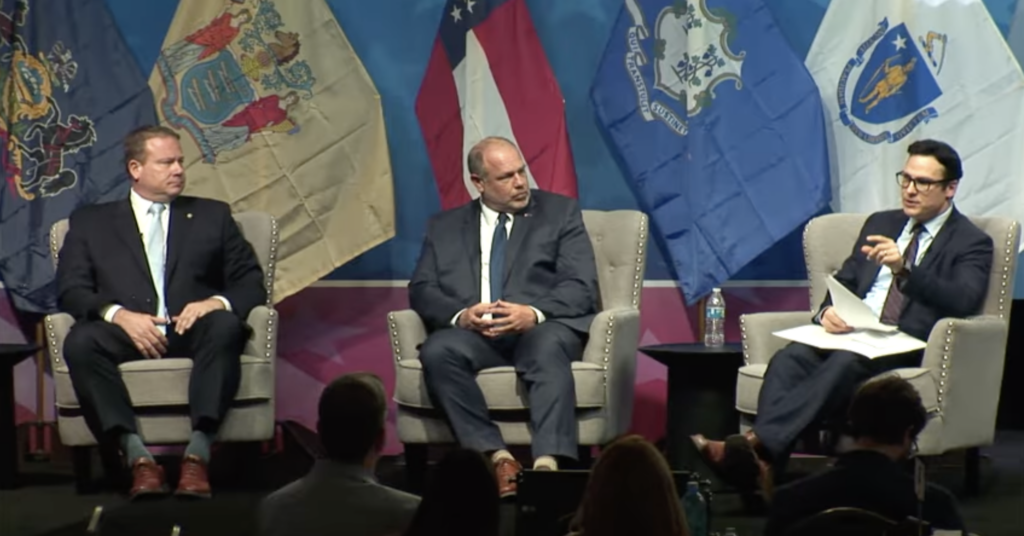
CAMP HILL — Speaking to a crowd at the annual Pennsylvania Leadership Conference on Saturday, former State Representative Andrew Lewis (R-Dauphin) shared his experience riding Hershey Park’s Triple Tower.
Despite his dislike of roller coasters, he agreed to board the 189-foot-tall ride with his son a few years ago to celebrate the young man’s eleventh birthday. Riders were strapped into their seats, speedily lifted to the top of the tower and, after a pause, dizzyingly dropped halfway down. The machine then shot the participants back up and down again several more times.
That minute or two didn’t move Lewis to a newfound love of thrill rides. Now the president of the Harrisburg-based Commonwealth Foundation (CF), he likened the ordeal to the Keystone State’s present political moment.
“That feeling of uncertainty and terror and, like, you don’t know if you’re going up, you don’t know if you’re going down: That’s exactly what it’s like to live in Pennsylvania with Josh Shapiro as governor,” he told the roomful of movement conservatives at the Penn Harris Hotel Harrisburg’s convention hall.
In a panel discussion on Shapiro’s record, Lewis and two of his former legislative colleagues, State Senate Appropriations Chairman Scott Martin (R-Lancaster) and State House Minority Leader Jesse Topper (R-Bedford), described a Democratic administration fraught with unwelcome surprises. The three cited education and energy policy as examples.
While Shapiro always typified Pennsylvania’s liberal political class in his coziness with teacher’s unions, he broke the mold in his 2022 campaign by saying he supported lifeline scholarships for students whose parents want them out of failing schools. But when the legislature passed a budget containing the school choice measure the following year, Shapiro caved to the House Democratic majority and organized labor by “blue-lining” the provision, i.e., striking it while leaving other expenditures in place.
Both Martin and Topper saw the decision as impairing the trust between the two parties in Harrisburg.
“Since he’s been in, if he’s in the building to even negotiate the budget, it’s been very difficult to really rally support, because people feel like, ‘Well, is he just going to blue-line again and line-item veto it?’” Martin said, lamenting the move’s aftereffects on subsequent budget negotiations.
Topper, himself a product of school choice as a homeschooled student, lamented what Shapiro’s failure to stand apart from his party on education will mean for thousands of public school students. Many, he noted, remain wait-listed for career and technical education programs because current capacity is insufficient to take all students who want to pursue those tracks.
“Our job as public policymakers is to ensure that every student has the opportunity to succeed,” he said. “And if we’re not doing that, then we’re failing. And I think that’s where you can hear the governor’s rhetoric on that versus the action, and you can see that we’re failing, because there are still students who are trapped inside failing schools.”
On energy, the lawmakers said, the governor has been equally erratic. Investors, they observed, have wanted to back new power-generation projects in the commonwealth, but those efforts have stalled as Shapiro waited until last year to drop his support for the Regional Greenhouse Gas Initiative (RGGI). The multi-state pact would have essentially imposed a tax on carbon emissions.
While Shapiro, who served as a state representative and later commissioner from Montgomery County before becoming attorney general and finally governor, was noncommittal about RGGI when campaigning for the state’s top job in 2022. But he appealed a Commonwealth Court ruling that tossed the initiative for lacking legislative approval; the governor then reversed himself in 2025 as part of budget negotiations with the Republicans who control the State Senate. (In his new memoir Where We Keep the Light, Shapiro suggests he always found RGGI too burdensome.)
Martin said the governor’s dalliance with RGGI had a lasting effect by discouraging investment in Pennsylvania and, in turn, putting upward pressure on energy prices, something for which he suggested Shapiro improperly blamed grid operator PJM.
“What he did was set the stage for increased pricing and what he did was set the stage for not having enough of that infrastructure built,” the appropriations chair explained.
The Republican leaders also criticized the governor’s current budget proposal, which relies on a drawdown of the state’s Budget Stabilization Reserve (or “rainy day”) Fund to mitigate Pennsylvania’s deficit. They furthermore blasted him for lacking transparency, with Martin recalling the executive branch stalled inquiries about why the gas-tax-supported Motor License Fund contains an unused $3 billion and the Public Transportation Trust Fund sits on $2.5 billion. All the while, transit agencies ask for $300 million more per year.
“I’ve never found it this difficult to get information,” the senator said.
In Lewis’s judgement, the totality of the governor’s record belies his self-portrayal as a man of action who likes to “get stuff done.” (He sometimes doesn’t use the word “stuff.”) CF’s own research finds Shapiro to be the least legislatively productive Pennsylvania governor of the last half-century in terms of legislation signed in his first two and a half years. Altogether, Shapiro signed 241 general acts or appropriations bills, the fewest of any comparable period in the last 50 years. Hence the panel’s title, “Ain’t Got Stuff Done: Examining Governor Shapiro’s Record.”
“There’s this kind of growing gap between his record and Shapiro’s real results,” Lewis said.
Shapiro’s communications office did not return an email requesting comment.
Bradley Vasoli is the senior editor of The Independence.