Lancaster discusses two-way plan for Orange and King streets with public
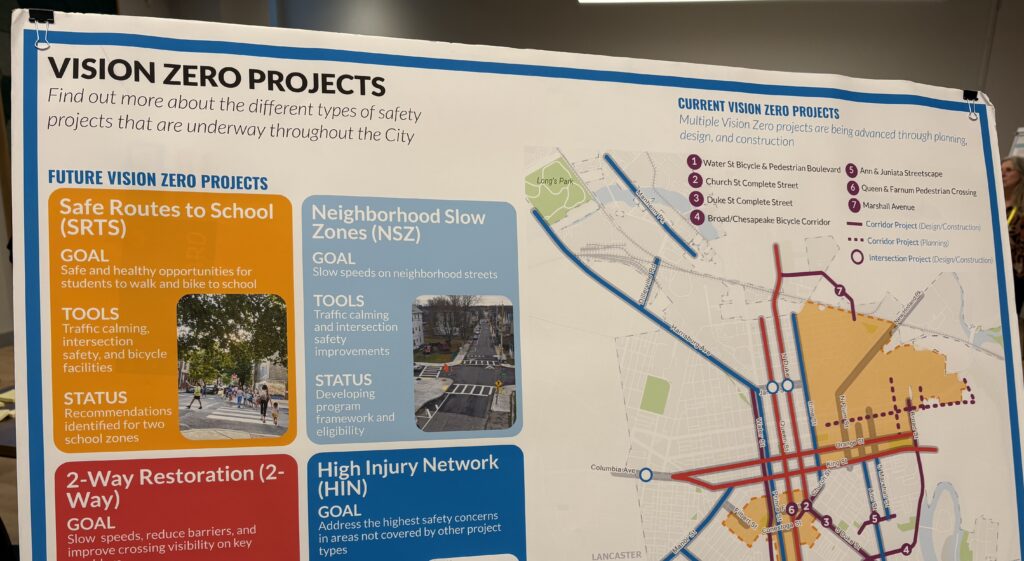
Maps of the City of Lancaster filled a room inside the Public Library. The Department of Public Works invited residents to an open house early Wednesday evening to view updates to the city’s two-way street restoration study. Lancaster joined the worldwide Vision Zero project several years ago. The goal is to reduce the number of traffic fatalities and serious injuries to zero by 2030.
“It’s a major undertaking,” said Public Works Deputy Director Cindy McCormick.
The city originally considered converting nine streets in the downtown area from one-way traffic to two-way. They included Queen, Duke, Prince, Lime, Church, King, Orange, Chestnut, and Walnut streets. But the focus has now turned to two: King and Orange. They move traffic east and west through the city, including around Penn Square.
“In our evaluations with consultants, these streets have been deemed suitable to the change,” said McCormick. “We are looking at detailed traffic models, the volume of traffic, and other impacts such as turning lanes and parking.”
The city received a $12.7 million federal grant from the Safe Streets and Roads for All program to pay for the changes.
“The north and south streets had more challenges,” said Laura Ahramjian, an associate planner with the consulting firm Kittelson & Associates, which developed initial designs for the project. “Orange and King Streets are the most doable in terms of two-way traffic. Penn Square is challenging, but we see it as an opportunity with great potential.”
While there are hundreds of crashes throughout the city each year, McCormick says data shows there are about 20 to 25 serious and fatal traffic accidents involving pedestrians in the downtown area. She says a majority occur on one-way streets.
“Two lanes in one direction encourages speeding, passing, and double parking, McCormick told The Independence. “Another major issue is yielding to pedestrians in crosswalks.”
The city previously converted Mulberry and Charlotte streets to two-way traffic with positive results, although they are less traveled than the higher-density downtown streets.
Studies also show an economic benefit to businesses, but, McCormick said, “safety for the public is our number one priority.”
It’s also the top priority for Lancaster’s new Police Chief Easter McDonald. He had served as assistant chief of police in Alexandria, Virginia, which also is part of the Vision Zero effort.
“We actually had zero fatalities and I’m hoping for something similar in Lancaster,” McDonald said. “It’s a very doable plan. Every life we save from a fatality and serious injury is to be applauded.”
Resident Pat Cluley believes the city is moving in the right direction with the plan to move to more two-way streets.
“I think it’s wonderful,” Cluley said. “They changed Mulberry and Charlotte and that works.”
She remembers a woman getting hit, not far from her home.
”She was walking across Prince and King Streets and was hit by a car,” an event Cluley said made her wary of crossing some streets. “Some intersections, you’re just afraid to cross. The sightlines are limited.”
Resident Tim Hassler isn’t convinced the changes will make streets safer.
“It’s hard to make changes in the core of downtown,” he said. “Orange and King streets are narrow. Buses have a hard time navigating around the square.”
Since the streets slated for change are state roads, the city is working with PennDOT to obtain the necessary permits.
Other traffic safety measures that are part of the plan include developing safe routes to schools by improving pedestrian crossings and adding walking and bike paths. City leaders are also looking at installing speed bumps and slow zones in neighborhoods in the southeast and southwest sections of Lancaster.
Following a second open house Thursday morning, the committee overseeing the vision Zero project will review the data and public input. The goal is to start final designs by the end of the year and implement the two-way traffic patterns within three years in the hope of saving lives.
Barbara Barr is a former reporter for WGAL in Pennsylvania’s Susquehanna Valley where she led political coverage that earned a Walter Cronkite Award.