As Kentucky Derby approaches, trainer remembers Barbaro
The 152nd running of the Kentucky Derby takes place Saturday at Churchill Downs in Kentucky. Twenty years ago in 2006, a horse named Barbaro, with southeastern Pennsylvania ties, ran to victory in the Run for the Roses.
Two weeks later, Barbaro shattered his leg following a false start in the Preakness Stakes, the second jewel in the Triple Crown.
Barbaro was taken to the New Bolton Center at the University of Pennsylvania in Chester County, where he underwent multiple surgeries. In the ensuing months, Barbaro developed laminitis, a painful condition affecting horses’ hooves, making it difficult for them to stand. Barbaro’s valiant fight ended January 29, 2007, when his owners Roy and Gretchen Jackson, along with his veterinarians, made the difficult decision to euthanize him.
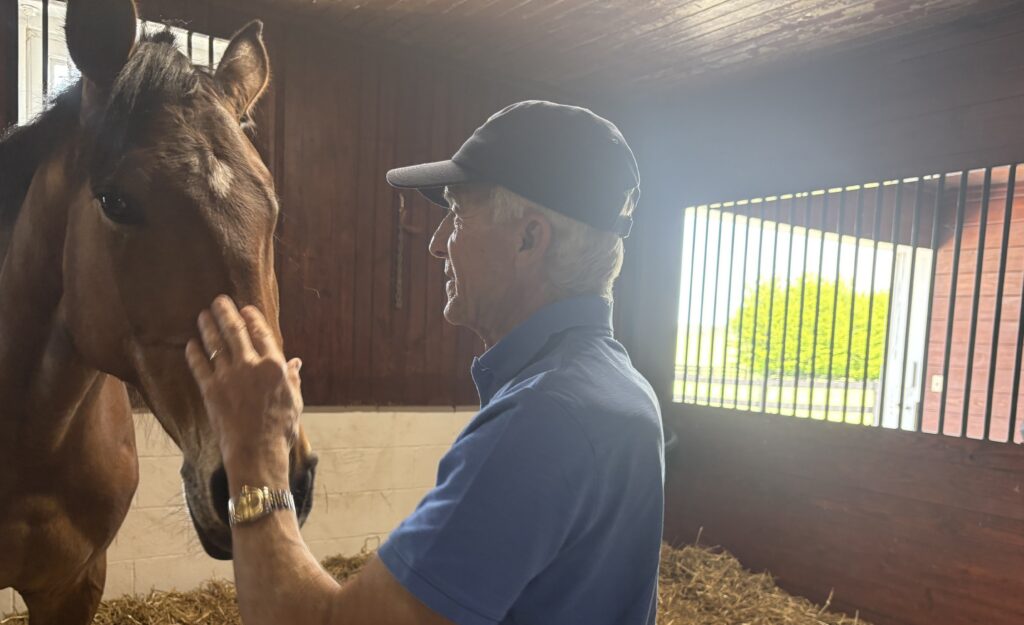
The Independence visited his trainer Michael Matz at his family horse farm in Coatesville, which sits amid the rolling hills of Chester County. He talked about the champion racehorse, called the “Peoples’ Horse,” the impact the horse had on Matz’s life, and Barbaro’s legacy.
“It’s certainly, obviously a good memory,” Matz recalled about Barbaro’s six-length win in the Kentucky Derby. “How good he was, nobody really knows. I was lucky, I had some of his brothers, but there was only one Barbaro.”
Matz described how he came to train Barbaro.
“He was a special horse,” he said. “I was lucky to get him. [Lael Stables owners] the Jacksons, who live not far from us, asked me to take some horses. They wanted to race their horses and not sell, so I was lucky enough to get a colt.”
Matz remembers his first impressions of the young horse.
“He came in and he was a big colt and obviously was very good looking and did everything the right way,” he said. “He was intelligent and loved to train. The only fault we had when we went to saddle him for the races [was that] he didn’t want to wait around more than three or four minutes. When you got the saddle on, he was a perfect gentleman.”
Barbaro won his first five races including the Florida Derby. Then it was on to Kentucky. Matz remembers being questioned for resting him five weeks before the Kentucky Derby.
“We just decided to stick with what the horse was used to,” he recalled.
The plan worked.
“I was worried about him with 20 horses in the field,” Matz said. “We did get a good post position. He did everything well. I was nervous about him breaking at the start. He fell a little to his knees. He was such an athletic horse, he got back in stride.”
The trainer described a riveting race.
“He was fourth or fifth going around the first turn,” he said. “After he got around the turn, was he good enough or not?”
He was, it turns out, more than good enough, pulling away and winning in what the announcer called “a sublime performance.”
Barbaro crossed the finish line by a wide margin.
“It was a very great moment,” Matz said. “The family was there. It was an incredible feeling.”
Photos of Barbaro’s victory in the Derby hang in the Matz home. The trainer pulled out other framed pictures along with a program from the Derby.
Barbaro was the favorite heading into the Preakness two weeks later. There were hopes he could win the Triple Crown. But things went wrong at the start. Barbaro broke through the metal starting gate early, hitting his head on the gate.
Matz said track veterinarians checked Barbaro and concluded it was safe to run him.
“Obviously if they felt he wasn’t sound, we wouldn’t have run him,” Matz said, adding that jockey Edgar Prado also thought the horse was alright.
But shortly after the restart, Barbaro broke down, fracturing his leg, stunning the crowd and those closest to him.
“Once the gate opened again, he made a bad step and that was what happened,” Matz said. “In two weeks, you went from the top of the mountain down to the lowest point you could be in. It seemed like we hardly got a chance to enjoy it.”
Barbaro was loaded into a trailer headed for the New Bolton Center. Matz followed behind.
“I woke up the next morning and didn’t even think it happened,” the trainer said. “It was more of a nightmare.”
Dr. Dean Richardson operated that day.
“It was a terrible break,” Matz said. “Dean did a nice job trying to get it back to where it was.”
More surgeries followed as laminitis began to develop in Barbaro’s other legs, making it difficult for him to stand and bear his weight.
“It was a rough eight months,” Matz recalled.
There were moments of hope followed by setbacks to Barbaro’s recovery. His struggle to overcome his injuries touched a nation including the surrounding communities in this part of Pennsylvania.
“People sent cards,” he said. “Kids from schools wrote books and drew pictures of him He brought racing and the public together. Even though it was a tragedy, he did make people aware of racing. He was such a great racehorse. And the way he fought to stay alive, he caught the public’s attention, was on the nightly news.”
The Jacksons visited Barbaro regularly throughout the horse’s courageous fight, which ended in late January of 2007.
“They wanted him to be able to have a good life, outside of racing,” Matz said.
But Barbaro’s owners determined his pain was too great, and made the difficult decision to put him down. Matz was remembers the telephone call he received when he was in Florida.
“No one wanted him to suffer,” he remembered. “I said, ‘Do what’s best for him.’ The Jacksons handled it with so much grace and dignity.”
Barbaro’s remains were cremated and later interred under a bronze statue of the Kentucky Derby Champion in front of Churchill Downs.
The Barbaro Fund for Excellence was created to raise money for research and treatment of laminitis and other equine health and safety issues. A spokesperson with the University of Pennsylvania’s School of Veterinary Medicine said the Barbaro Fund, together with a laminitis fund, has raised close to $12 million.
“After Barbaro’s case, there was an exponential increase in interest and funding in laminitis research, and we owe a lot to Roy and Gretchen Jackson, his owners,” Penn Vet Professor Andrew van Epps told The Independence. “Our progress is part of the Barbaro legacy.”
Matz went on to train a Belmont Stakes champion in Union Rags. He continues to train thoroughbreds at Fair Hill Training Center in Maryland.
The 75-year-old Matz has had a remarkable life on and off the track. He raises horses on the farm as we walk through the barn where show-jumping horses munch on hay.
His love of horses began as a child in Shillington, Berks County. A family friend raised them. Matz began show jumping. He won gold medals at the World Championships competed in three Olympics, winning a team silver medal at the 1996 Olympics. He was inducted into the Show Jumping Hall of Fame. He carried the United States flag in the closing ceremonies at the Atlanta Olympics.
“Winning the Derby, carrying the flag, those are things you don’t dream about in your lifetime,” Matz said.
Seven years earlier, Matz was recognized for heroically helping to save four children, including a baby, from the crash of United Airlines Flight 232 in Iowa. The fiery crash killed 112 people. Matz and his wife D.D. were among the survivors.
“That’s something else you don’t put in your life that you think is going to happen to you,” Matz said modestly.
When asked about his own legacy, Matz paused before answering.
“Trying to do the right thing the right way,” he said. “Treat people like you want them to treat you.”
As for Barbaro’s legacy, Matz agreed with owner Roy Jackson.
“He brought a lot of the racing community together,” Matz said. “I think, obviously, it was meant to be that way. The question is, ‘How good was he?’ It will always be in the back of our minds.
But as the Derby approaches, he knows this much: “To get a horse like Barbaro, that was hitting the lottery.”
When post time arrives at Churchill Downs, Matz’s thoughts will be on that magical day 20 years ago.
Barbara Barr is a former reporter for WGAL in Pennsylvania’s Susquehanna Valley where she led political coverage that earned a Walter Cronkite Award.